Choosing the right tech product in today’s U.S. market can feel overwhelming — especially for remote workers, home office professionals, and small business owners trying to balance performance, budget, and long-term value.
With endless “best tech” lists, influencer recommendations, and spec-heavy product pages competing for your attention, the real challenge isn’t finding options — it’s making the right decision confidently.
Whether you’re upgrading your home office setup, replacing a work laptop, investing in productivity tools, or evaluating new remote work equipment, the key is not chasing trends — it’s following a structured tech buying decision framework.
This step-by-step guide will show you exactly how to evaluate, compare, and choose the right tech product based on your workflow, budget, compatibility needs, and long-term reliability — so you avoid overspending, buyer’s remorse, and unnecessary upgrades.
How to Choose a Tech Product (Quick Answer)
To choose the right tech product, identify your primary purpose, set a realistic budget, compare key specifications, research verified user reviews, check compatibility with your existing devices, evaluate vendor reliability and support, and consider long-term value including software updates and repairability.
The best tech product is not necessarily the most popular tech or the most expensive model — it is the one that aligns with your daily workflow, technical requirements, and future needs.
A tech product refers to any electronic device or software designed to improve productivity, communication, entertainment, or connectivity in daily life.
Who This Guide Is For
This guide is designed specifically for:
- Remote workers building or upgrading a home office
- U.S.-based professionals buying productivity tech
- Freelancers and small business owners evaluating equipment
- Anyone confused by specifications, marketing hype, or conflicting reviews
- Buyers who want a structured, practical approach instead of impulse decisions
If you want clarity before spending your hard-earned money — not just another “top 10” list — this guide is built for you.
Popular Types of Tech Products in 2026
When people search for top tech products or popular tech, they usually mean one of these major categories:
- Smartphones
- Laptops & Desktops
- Tablets
- Smart Home Devices
- Wi-Fi Routers & Networking Equipment
- Wearables (Smartwatches, Fitness Trackers)
- Audio Devices (Headphones, Speakers)
- Gaming Accessories
- Best Tech Under $200
- Trending Tech Products for Home Office & Remote Work
Understanding the category you’re buying from helps narrow your decision and prevents confusion when comparing multiple high tech products.
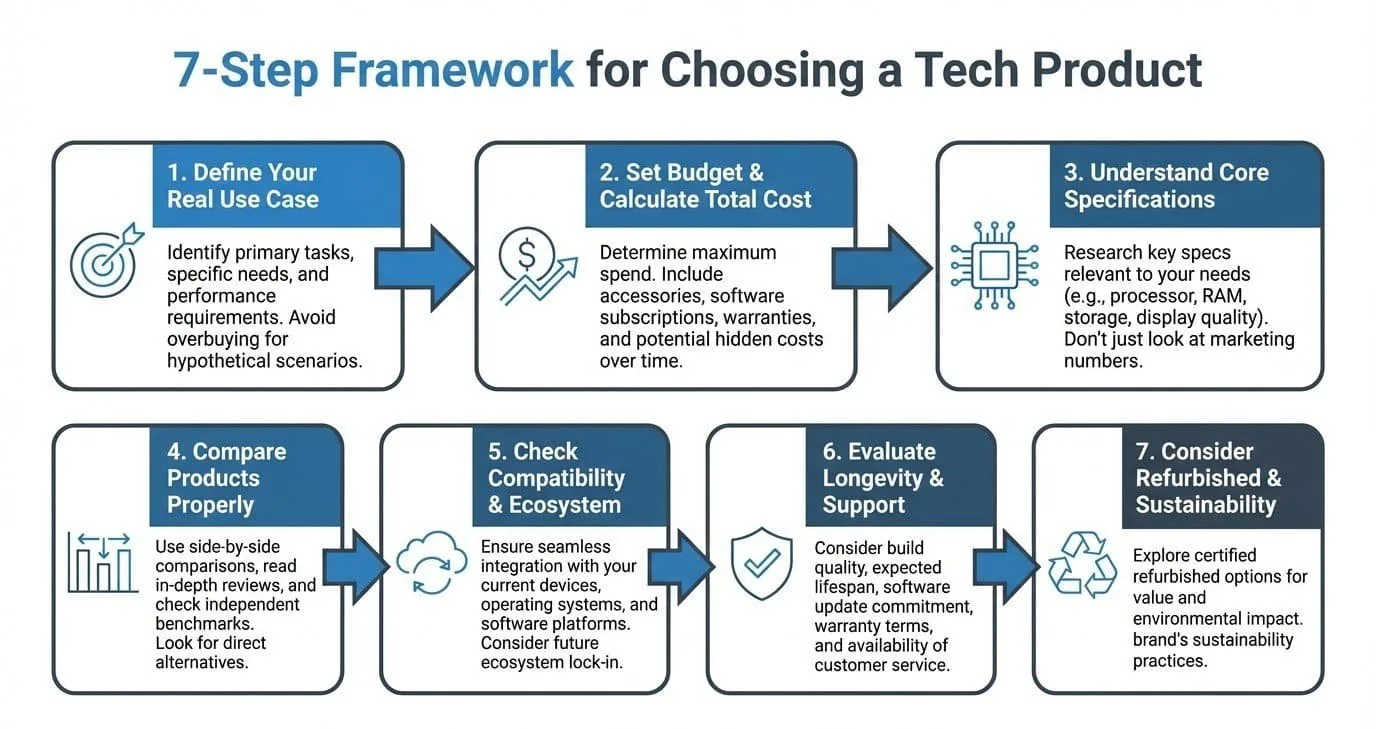
7-Step Framework for Choosing the Right Tech Product
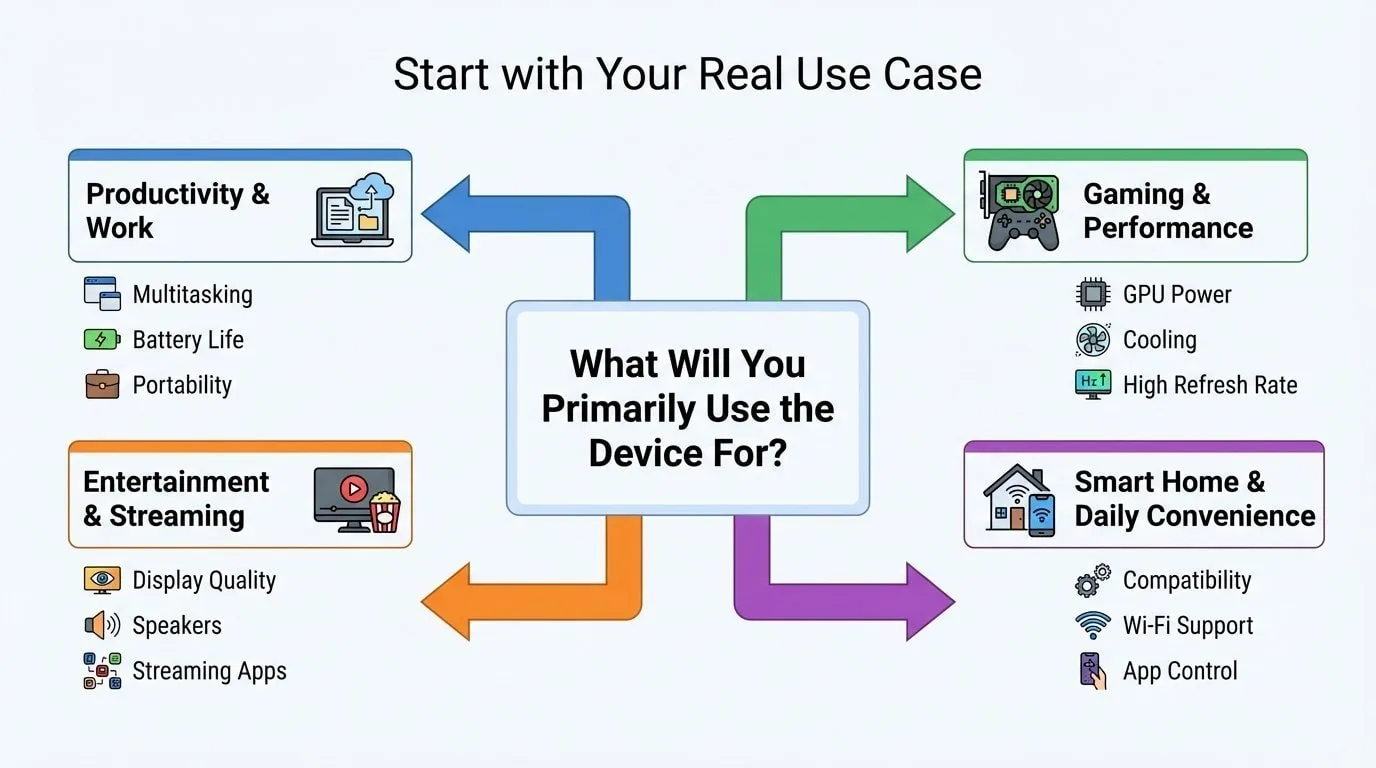
Step 1 – Identify Your Primary Purpose Before Comparing Specs
The biggest mistake people make when buying tech for a home office or remote work setup is starting with specifications instead of purpose.
Before you compare RAM, CPU speeds, or refresh rates, ask:
- What type of work do I actually do every day?
- Do I need portability or a fixed desk setup?
- What tools and software do I rely on?
Technology should support your workflow — not complicate it.
Productivity vs Creative Work vs Communication
A home office setup looks very different depending on your primary tasks.
For example:
General productivity (email, documents, browsing, spreadsheets)
You need reliability, strong battery life, a comfortable keyboard, and stable Wi-Fi — not high-end graphics.
Creative work (video editing, design, coding)
You may need more RAM, faster processors, better displays, and stronger storage solutions.
Client-facing work (Zoom calls, virtual meetings, online training)
A quality webcam, microphone, and strong internet connection become more important than raw processing power.
Clarity here prevents overspending and underbuying.
Portable vs Desk-Based Setup
If you work from cafés, travel frequently, or commute occasionally, portability matters:
- Lightweight laptop
- Long battery life
- Durable build
- Compact charger
If your home office is permanent and stationary:
- Larger monitor
- Ergonomic accessories
- Upgradeable desktop setup
- External storage
- Docking stations
Many buyers pay for ultra-thin portability they don’t actually need. Others underestimate the importance of display size or keyboard comfort for long work sessions.
Match the device to your daily reality.
Must-Have vs Nice-to-Have Features
Once you define purpose and mobility, separate features into two simple categories:
Must-have features
These are non-negotiable requirements. Without them, the device fails your needs.
Examples:
- Minimum RAM requirement for your workload
- Specific software compatibility
- Required ports (USB-C, HDMI)
- Minimum battery life
- Required storage capacity
Nice-to-have features
These improve experience but are not essential.
Examples:
- Extra RGB lighting
- Ultra-high refresh rates when you don’t game
- Advanced camera modes you rarely use
- Premium materials that increase price but not functionality
This distinction is powerful. It prevents feature overload and marketing distraction.
When learning how to choose the best tech, clarity about essentials versus enhancements keeps your budget focused on what actually matters.
Avoid Trend-Based Buying
Technology trends move fast. Social media, influencer reviews, and “Best Tech of the Year” lists often create pressure to upgrade — even when your current device works perfectly fine.
Trend-based buying usually leads to:
- Overpaying for features you don’t use
- Buying into ecosystems you’re not ready for
- Replacing functional devices prematurely
- Accumulating unused gadgets
Instead of asking, “What’s the most popular tech right now?” ask:
- Does this solve a problem I genuinely have?
- Will I use this consistently six months from now?
- Does it improve efficiency or just add novelty?
A thoughtful tech buying guide always prioritizes practicality over popularity.
This applies whether you’re choosing productivity tools, gaming devices, smart home equipment, business software, or even exploring tech product ideas. The clearer your purpose, the easier it becomes to choose the product that truly fits your needs.
Step 2 – Set a Budget & Calculate the Total Cost of Ownership
Most buyers focus only on the number shown on the product page. But the smartest tech buyers — especially in the U.S. market — think beyond the initial purchase price.
If you truly want to choose technology wisely, you need to calculate the total cost of ownership (TCO) — the full cost of using that device over its lifespan.
A cheaper product isn’t always cheaper in the long run. And a higher upfront cost doesn’t always mean overspending. The difference lies in understanding long-term value.
Initial Price vs Long-Term Cost
The price tag is only the beginning.
When comparing two devices, ask:
- How long is this product likely to last?
- How long will it receive software updates?
- Will it still perform well in 3–5 years?
- Does it hold resale value?
For example, a $600 laptop that struggles after two years may cost more over time than a $900 device that performs reliably for five years. If you divide the cost by usable years, the more expensive option may actually deliver better value per year.
This is especially important in the United States, where rapid upgrade cycles and marketing pressure encourage frequent replacements. Choosing a device built for longevity reduces both cost and frustration.
Think in terms of cost per year of usage, not just purchase price.
Subscription & Accessory Costs
Many modern tech products are part of larger ecosystems. The device itself may be affordable — but the ongoing costs can add up quickly.
Before buying, consider:
- Cloud storage subscriptions
- Streaming service fees
- Premium app memberships
- Smart home service plans
- Extended warranties
- Software licenses
Accessories also increase total spending:
- Cases and screen protectors
- Chargers and cables
- External storage
- Docking stations
- Headphones or controllers
For example, a printer may seem affordable at first, but recurring ink cartridges can significantly increase long-term cost. A smartwatch might require a premium app subscription to unlock advanced features.
When evaluating how to choose the best tech for your needs, always calculate the ecosystem cost — not just the hardware cost.
Maintenance & Repair Costs
Another overlooked factor is repairability and maintenance.
Ask:
- Is the battery replaceable?
- Are spare parts available in the U.S.?
- Is repair expensive or restricted?
- Does the brand offer reliable service centers?
Devices that are difficult or expensive to repair may force premature replacement. On the other hand, products with accessible repair options and solid manufacturer support tend to last longer.
You should also check:
- Warranty duration
- What the warranty covers
- Whether accidental damage protection is worth it
Some premium devices are expensive to fix out of warranty. Understanding repair costs ahead of time prevents unpleasant surprises.
When Paying More Actually Saves Money
It may sound counterintuitive, but sometimes paying more upfront is the financially smarter choice.
You might consider paying more when:
- The device offers significantly longer software support.
- Build quality is clearly superior.
- Performance headroom prevents early obsolescence.
- Warranty coverage is stronger.
- Battery life reduces daily inconvenience.
Mid-range products often provide the best balance of performance and cost for most users. Ultra-budget options can cut corners in durability or update support, while ultra-premium devices may offer diminishing returns unless you truly need the performance.
The goal is not to buy the cheapest option — nor the most expensive — but to choose the device that delivers the strongest combination of usability, durability, and long-term value.
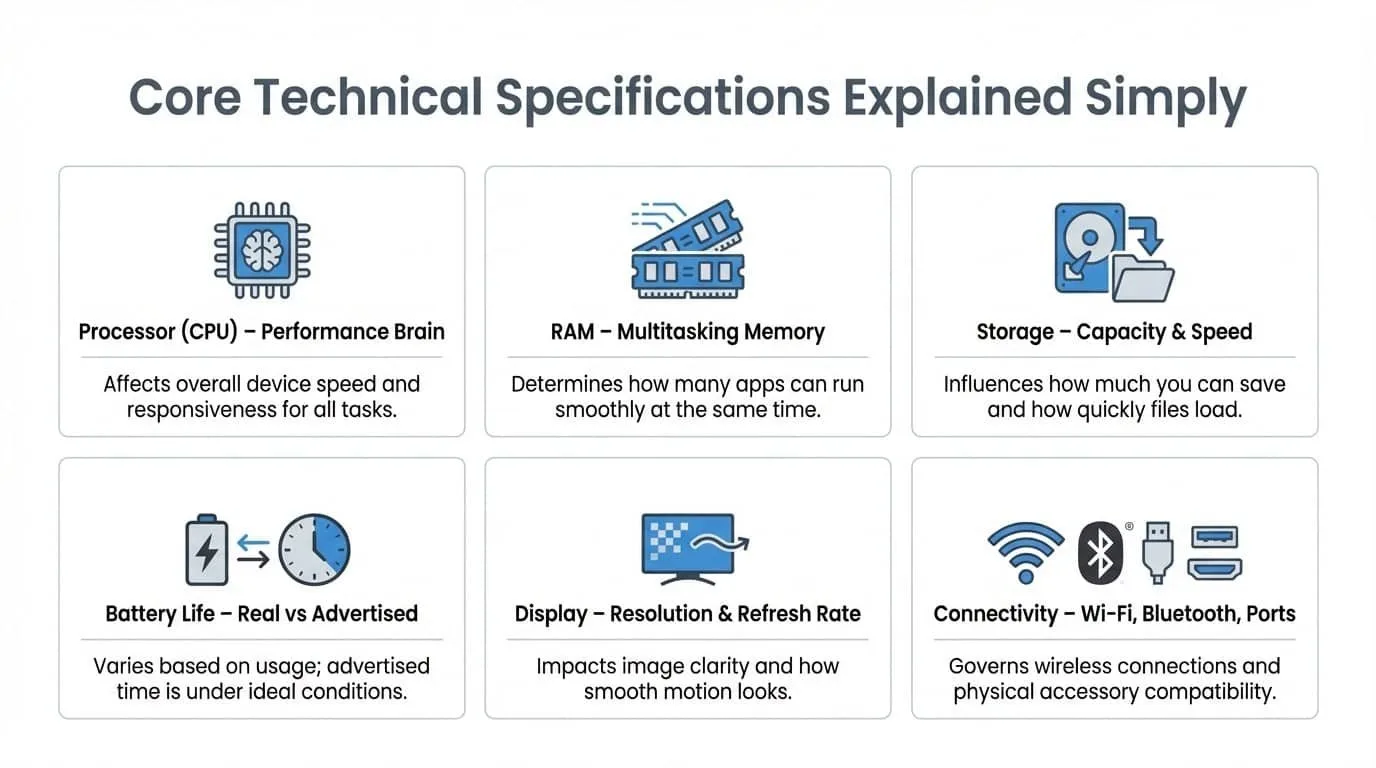
Step 3 – Understand the Core Technical Specifications
Once your purpose and budget are clear, the next step in learning how to choose a tech product is understanding the specifications that actually impact performance.
Specifications are not just numbers on a product page. They determine how smoothly your device runs, how long it lasts, and whether it will still feel usable a few years from now.
But here’s the key: you don’t need to understand everything. You only need to understand the specifications that matter for your use case.
Let’s break them down in simple, practical terms.
Processor (CPU) Explained Simply
The processor — often called the CPU — is the “brain” of the device. It handles calculations, runs applications, and determines how fast your system responds.
In simple terms:
- A stronger processor = better multitasking and faster performance.
- A weaker processor = slower load times and limited performance under heavy tasks.
For basic tasks like web browsing, streaming, email, and document editing, mid-tier processors are more than sufficient.
For gaming, video editing, software development, or 3D work, higher-performance CPUs (and often dedicated GPUs) become important.
Instead of chasing the newest chip model, ask:
- Does this processor support the type of work I actually do?
- Will it still feel responsive in 3–4 years?
Avoid paying for extreme performance if your tasks don’t require it.
RAM – How Much Is Enough?
RAM (Random Access Memory) affects how many tasks your device can handle at once without slowing down.
If you’ve ever experienced lag while switching between apps or browser tabs, insufficient RAM may have been the cause.
As a general guideline:
- 8GB RAM works well for everyday productivity and casual use.
- 16GB RAM is ideal for multitasking, creative work, and gaming.
- 32GB+ is usually reserved for heavy professional workloads.
Instead of guessing, it’s important to understand what RAM actually does and how much you realistically need for your workload.
As explained in our detailed guide on what RAM is and how much you need, understanding memory requirements prevents both overspending and performance issues.
Choosing the right amount of RAM prevents overspending — and also prevents underperformance.
Storage – Capacity & Speed
Storage determines how much data your device can hold — but speed matters just as much as capacity.
There are two main considerations:
Capacity (How Much Space You Need)
- 256GB is often sufficient for light users.
- 512GB or 1TB may be necessary for creators, gamers, or professionals dealing with large files.
- Cloud storage can supplement local storage — but may involve recurring costs.
Speed (SSD vs HDD)
Solid State Drives (SSD) are significantly faster than traditional Hard Disk Drives (HDD). SSDs improve:
- Boot times
- App loading speed
- File transfer performance
- Overall system responsiveness
For most modern devices, an SSD is strongly recommended. Speed impacts daily experience more than raw capacity alone.
Battery Life – Real vs Advertised
Manufacturers often advertise battery life under ideal test conditions. Real-world usage typically varies based on:
- Screen brightness
- Background apps
- Wi-Fi or cellular usage
- Gaming or heavy tasks
Instead of relying only on marketing claims:
- Look at independent reviews.
- Read long-term user feedback.
- Check whether fast charging is supported.
- Consider battery degradation over time.
If portability is important in your daily life — commuting, travel, remote work — battery life becomes a critical factor in how to choose the best tech for your needs.
Display & Build Quality
Display quality affects how comfortable and enjoyable the device feels during daily use.
Key elements to evaluate:
- Resolution (Full HD, 4K, etc.)
- Brightness (important for outdoor use)
- Refresh rate (60Hz vs 120Hz for smoother scrolling/gaming)
- Panel type (LCD vs OLED)
For most users, Full HD resolution with decent brightness is sufficient. Higher refresh rates are more noticeable for gamers and heavy scrolling users.
Build quality also matters for longevity:
- Aluminum or reinforced materials often last longer.
- Hinge strength (for laptops) affects durability.
- Water and dust resistance ratings can protect mobile devices.
A well-built device often ages better than one that looks premium but lacks structural durability.
Connectivity & Future-Proofing
Technology evolves quickly, so future-proofing matters.
Check for:
- USB-C ports
- Wi-Fi 6 or newer standards
- Bluetooth 5.0+
- Expandable storage (if available)
- HDMI or Thunderbolt support (for laptops)
Future-proofing doesn’t mean buying the most advanced model — it means ensuring the device won’t become outdated too quickly.
For example:
A laptop without modern ports may require constant adapters. A device without current wireless standards may struggle with newer routers or accessories.
When selecting technology, think 3–5 years ahead — not just today.
Step 4 – Compare Products Properly (Side-by-Side Strategy)
Once you understand your purpose, budget, and key specifications, the next step in learning how to choose a tech product is comparison — but done the right way.
Randomly jumping between product pages often increases confusion. Instead, structured comparison brings clarity.
This structured tech evaluation method removes emotion from the buying process and replaces it with logical decision-making.
The goal isn’t to find the “best overall” device — it’s to find the best fit within your specific range and use case.
Compare Within the Same Price Tier
One of the most common mistakes is comparing devices that don’t belong in the same category.
For example:
- Comparing a $600 laptop to a $1,200 laptop will almost always make the cheaper option look weaker.
- Comparing an entry-level smartphone to a flagship model can create unrealistic expectations.
Instead:
- Define your budget range first.
- Compare devices within that same price bracket.
- Evaluate what each brand offers for a similar cost.
When you compare within the same tier, the decision becomes about value, not aspiration.
Sample Side-by-Side Comparison Table
Here’s a simplified example of how you can structure your evaluation:
| Feature | Device A | Device B | Device C |
|---|---|---|---|
| Processor | Mid-tier | Mid-tier | Higher-tier |
| RAM | 8GB | 16GB | 16GB |
| Storage | 512GB SSD | 512GB SSD | 1TB SSD |
| Battery (Rated) | 10 hrs | 12 hrs | 9 hrs |
| Display | Full HD | Full HD | 2K |
| Upgradeable? | No | Yes | No |
| Warranty | 1 Year | 1 Year | 1 Year |
| Price | $699 | $799 | $999 |
This format forces objective comparison.
Instead of asking:
“Which one looks better?”
You ask:
“Which one gives me the strongest combination of what I actually need?”
That’s how structured tech buying guides prevent confusion.
If you want a deeper breakdown of this process, read our guide on how to compare tech products like a pro for a practical side-by-side evaluation strategy.
Evaluate Trade-Offs
No device is perfect.
Every tech product is a compromise between performance, portability, price, battery life, and build quality.
For example:
- A thinner laptop may sacrifice cooling performance.
- A powerful gaming device may have shorter battery life.
- A lower-priced device may limit upgrade options.
- A premium build may increase cost without improving speed.
When comparing products, identify what each device sacrifices.
Ask:
- What am I gaining?
- What am I giving up?
- Does the trade-off align with my use case?
Understanding trade-offs turns comparison from emotional reaction into strategic evaluation.
Don’t Overweight Brand Reputation
Brand reputation matters — but it should not be the only deciding factor.
Popular brands often command higher prices because of ecosystem integration, marketing strength, and perceived reliability. However:
- A well-known brand may still underperform in certain categories.
- A lesser-known brand may offer better specifications within the same budget.
- Brand loyalty can sometimes prevent objective evaluation.
Instead of asking:
“Which brand is more popular?”
Ask:
“Which model within my budget tier delivers the strongest balance of performance, compatibility, support, and long-term value?”
Brand trust should support your decision — not replace your analysis.
Step 5 – Check Compatibility & Ecosystem Lock-In
A device might look perfect on paper — great processor, solid battery life, attractive price — but if it doesn’t work smoothly with what you already own, frustration can build quickly.
Compatibility is not just about cables and ports anymore. It’s about ecosystems.
Modern tech products are deeply connected. Phones sync with laptops. Smartwatches depend on smartphones. Smart home devices rely on apps, hubs, and cloud accounts. Once you enter an ecosystem, switching can become expensive or inconvenient.
Before making a purchase, pause and ask:
- How will this device fit into what I already use?
- Am I entering an ecosystem I’m ready to commit to?
Understanding ecosystem lock-in is essential if you want to choose technology confidently rather than reactively.
Operating System Ecosystem
Operating systems shape your daily experience more than hardware alone.
For example:
- Apple devices (iOS, macOS, iPadOS) are designed to work seamlessly together.
- Windows laptops integrate well with Microsoft services.
- Android devices vary by manufacturer but integrate deeply with Google services.
If you already use an iPhone, buying a smartwatch that integrates smoothly with iOS may offer a better experience than one designed primarily for Android. Similarly, if you rely heavily on Google Drive, Gmail, or Microsoft Office, choosing a device optimized for those platforms improves efficiency.
Switching ecosystems isn’t impossible — but it often requires adjusting habits, migrating data, and sometimes repurchasing apps or accessories.
Compatibility isn’t about brand loyalty. It’s about workflow continuity.
Cross-Device Sync
Seamless syncing can quietly improve productivity.
Consider how your devices interact:
- Does your laptop sync notes and files automatically with your phone?
- Can you copy text on one device and paste it on another?
- Do photos upload instantly across devices?
- Can you answer calls or messages from multiple devices?
Cross-device features often become part of your routine without you noticing — until they stop working.
When comparing products, look beyond individual specs and ask:
- Will this device integrate smoothly into my daily tech routine?
- Or will it require constant manual transfers and adjustments?
Convenience compounds over time. A device that syncs effortlessly often feels more valuable than one with slightly higher raw performance.
Cloud & Subscription Dependency
Many modern devices rely heavily on cloud services.
Examples include:
- Cloud storage for photos and backups
- Smart home automation platforms
- Security camera subscriptions
- Streaming-based gaming services
- AI-powered productivity tools
Before committing, understand:
- Is this device usable without a paid subscription?
- What features are locked behind monthly plans?
- If I stop paying, what functionality do I lose?
A product that seems affordable upfront can become costly over time if core features require ongoing payments.
This doesn’t mean subscriptions are bad — but you should enter them consciously.
When choosing a tech product, long-term ecosystem costs matter as much as hardware.
Smart Home & Interoperability
If you’re investing in smart home technology in the United States, compatibility becomes even more important.
Different brands may support different standards and platforms. Devices may advertise smart features but only work fully within specific ecosystems.
Before buying:
- Confirm compatibility with your existing smart assistant (if any).
- Check whether devices can communicate with each other.
- Verify app support and update frequency.
- Look for open standards that allow flexibility.
Poor interoperability can lead to isolated devices that don’t communicate well — reducing the convenience you expected.
Smart home technology works best when planned, not purchased impulsively.
Step 6 – Evaluate Longevity, Upgrade Potential & Support
A tech product should not only work well today — it should still feel reliable two, three, or even five years from now.
When people ask how to choose a tech product wisely, they often focus on performance and price but overlook longevity. Yet durability, update support, and upgrade flexibility are what truly determine whether a device delivers long-term value.
Before finalizing your decision, look beyond the launch-year performance and consider how the device will age.
Software Update Lifecycle
Hardware may still function perfectly, but without software updates, it gradually becomes less secure and less compatible.
Software updates usually include:
- Security patches
- Performance improvements
- Bug fixes
- Compatibility with new apps and services
Devices that stop receiving updates can become vulnerable or incompatible with newer applications over time.
Before buying, research:
- How long does the manufacturer typically provide operating system updates?
- How long are security patches supported?
- Does the brand have a consistent update history?
Some brands are known for extended update policies, while others limit support for lower-tier models. This matters especially if you plan to keep the device for several years.
A device with longer update support often delivers better long-term value — even if its initial price is slightly higher.
Upgradeability (RAM, Storage)
Upgradeability gives your device breathing room.
Some laptops and desktops allow you to:
- Add more RAM later
- Replace storage drives
- Upgrade components over time
Other devices — especially ultra-thin designs — may have soldered components that cannot be upgraded.
Before buying, ask:
- Is the RAM upgradeable?
- Can storage be expanded?
- Are there accessible upgrade slots?
If you anticipate heavier workloads in the future, upgrade flexibility can extend the usable life of the device significantly.
For smartphones and tablets, upgradeability is often limited — so choosing the right configuration from the start becomes more important.
Thinking ahead reduces the chance of premature replacement.
Repairability
No device lasts forever without maintenance.
Batteries degrade. Screens crack. Ports wear out.
Repairability affects how affordable and practical it is to extend a device’s life.
Consider:
- Is the battery replaceable?
- Are spare parts available?
- Are authorized repair centers accessible in your region?
- Does the brand restrict independent repairs?
Some devices are designed to be serviced more easily than others. Limited repair options can increase total ownership cost and reduce lifespan.
Before purchasing, check whether repair support is available in the United States and how costly typical repairs are.
A device that can be repaired easily often outlasts one that must be replaced entirely for minor issues.
Manufacturer Support
Beyond warranty length, evaluate the quality of support.
Look at:
- Warranty duration
- What the warranty covers
- Customer service reputation
- Speed of service resolution
A one-year warranty is common, but the experience behind that warranty varies widely between brands.
If a company has poor service responsiveness, even a strong product can become frustrating when issues arise.
Support quality is difficult to measure — but reading verified user feedback can reveal patterns.
Vendor Reliability
Reliability is about consistency.
Some brands release excellent flagship products but cut corners in mid-range models. Others maintain steady quality across tiers.
Ask:
- Does this company have a track record of durable products?
- Are there recurring complaints about overheating, battery degradation, or hardware failure?
- Is the brand stable and likely to continue supporting its devices?
Vendor reliability becomes even more important if you’re investing in an ecosystem — such as smart home devices or cloud-integrated hardware.
Longevity is not only about the device — it’s about the company behind it.
Step 7 – Consider Refurbished & Sustainable Options
When learning how to choose a tech product, many people assume the only smart option is buying brand new. But that’s not always true.
In many cases, refurbished or certified pre-owned devices can offer significant savings without sacrificing performance — especially if you understand how to evaluate them properly.
At the same time, technology purchases have an environmental impact. Making thoughtful decisions not only protects your budget but also reduces unnecessary waste.
This step is about balancing value, reliability, and responsibility.
When Refurbished Makes Sense
Buying refurbished can make sense when:
- You want premium performance at a lower cost.
- A previous-generation model still meets your needs.
- You don’t require the absolute newest features.
- You’re working within a tighter budget.
For example, last year’s flagship laptop or smartphone often performs nearly as well as the newest release — but at a noticeably lower price.
In many cases, depreciation happens quickly after launch. A refurbished model allows you to benefit from that price drop without compromising everyday performance.
If your use case doesn’t demand cutting-edge specs, refurbished devices can deliver strong long-term value.
Certified vs Unverified Refurbished
Not all refurbished products are equal.
There’s a major difference between:
Certified refurbished devices
- Inspected and tested by the manufacturer or authorized seller
- Repaired with genuine parts if needed
- Often include warranty coverage
- Usually come with a return policy
And:
Unverified refurbished or used devices
- Sold by third-party individuals
- May lack warranty
- May not be fully tested
- May carry hidden defects
When buying refurbished in the United States, prioritize:
- Manufacturer-certified refurbished programs
- Authorized retailers
- Clear warranty coverage
- Transparent return policies
This reduces risk and increases confidence.
Buying refurbished should feel intentional — not risky.
Environmental Impact
Every new electronic device requires materials, energy, and transportation to produce. Choosing devices that last longer — or extending the life of existing hardware — reduces overall environmental impact.
Refurbished products help:
- Reduce manufacturing demand
- Lower resource consumption
- Decrease landfill waste
- Extend the life cycle of functional hardware
Even if sustainability isn’t your primary motivation, choosing durable devices with longer support cycles naturally reduces waste.
Longevity and sustainability often align with smarter financial decisions.
Electronic Waste Awareness
Electronic waste (e-waste) is a growing global issue. Discarded devices often contain valuable materials but also hazardous components.
Before upgrading, ask:
- Does my current device still meet my needs?
- Can upgrading RAM or storage extend its life?
- Would a battery replacement restore usability?
- Can I resell or recycle responsibly?
In the U.S., many retailers and manufacturers offer recycling programs. Taking advantage of these programs ensures responsible disposal rather than unnecessary landfill waste.
Sustainable tech buying isn’t about guilt — it’s about making informed, practical choices.
Why User Experience (UX) Matters When Choosing Tech
Specifications alone don’t determine satisfaction. A device may look powerful on paper but feel frustrating during everyday use.
When evaluating user experience, consider:
- Interface simplicity
- Ease of navigation
- Comfort during long sessions
- Learning curve
- Responsiveness
- Overall workflow efficiency
For personal use, user-friendliness and portability often matter more than raw performance. For business or professional environments, efficiency and reliability are critical.
Good user experience reduces friction and increases long-term satisfaction.
How to Buy a Tech Product in the USA
Choosing the right device is only part of the process. Knowing the ideas of buying tech products strategically can save you hundreds of dollars and prevent unnecessary stress.
The U.S. market offers competitive pricing, seasonal discounts, strong return policies, and multiple purchasing channels — but it also comes with considerations like sales tax, protection plans, and warranty differences.
If you’re shopping in the United States, these practical factors matter just as much as specifications.
Best Time to Buy Tech in the USA
Timing your purchase can significantly affect price.
Major sales periods in the U.S. include:
- Black Friday & Cyber Monday (November)
- Back-to-School Season (July–September)
- Prime Day (mid-year event)
- Holiday sales periods
- New model release cycles
When new models launch, previous-generation devices often drop in price while still delivering excellent performance.
If your purchase isn’t urgent, waiting for seasonal sales can increase value without sacrificing quality.
Understanding Return Policies
Return policies in the U.S. are generally consumer-friendly — but they vary by retailer.
Before purchasing, check:
- Return window (14 days, 30 days, etc.)
- Whether opened electronics are eligible for full refund
- Restocking fees (if any)
- Return shipping policies
A generous return policy allows you to test the product in your real environment instead of relying solely on showroom impressions or online reviews.
This is especially helpful when evaluating comfort, performance, or ecosystem compatibility.
Manufacturer Warranty vs Retailer Warranty
Not all warranties are equal.
Most electronics come with a manufacturer’s limited warranty, typically covering defects for one year. However, some retailers offer extended protection plans for an additional cost.
Before purchasing an extended warranty, consider:
- How reliable the device category typically is
- Repair cost compared to warranty price
- Whether accidental damage protection is included
- Your personal risk tolerance
In some cases, extended protection may provide peace of mind. In others, it may not justify the added cost.
Understanding warranty coverage prevents confusion later.
Sales Tax Considerations
Unlike advertised prices, the final cost in the U.S. often includes state and local sales tax, which varies by location.
When budgeting:
- Factor in sales tax to avoid exceeding your planned budget.
- Compare total checkout price, not just listed price.
- Be aware of online vs in-store pricing differences.
Small differences can become noticeable for high-ticket purchases like laptops or premium smartphones.
Buying Refurbished or Open-Box in the USA
The U.S. market offers strong certified refurbished and open-box options through:
- Manufacturer-certified programs
- Major retailers
- Authorized resellers
Open-box items (returned but unused or lightly used) can provide additional savings, often with warranty coverage.
If buying refurbished:
- Confirm warranty status.
- Ensure return policy applies.
- Verify that the device is not activation-locked or carrier-locked.
Done correctly, refurbished buying in the U.S. can deliver strong value with minimal risk.
Online vs In-Store Purchase
Both options have advantages.
Online purchases:
- Broader selection
- Easier price comparison
- Convenient home delivery
- Often better promotional deals
In-store purchases:
- Hands-on testing
- Immediate pickup
- Face-to-face support
The right choice depends on your comfort level and urgency.
Common Mistakes to Avoid When Choosing Tech Products
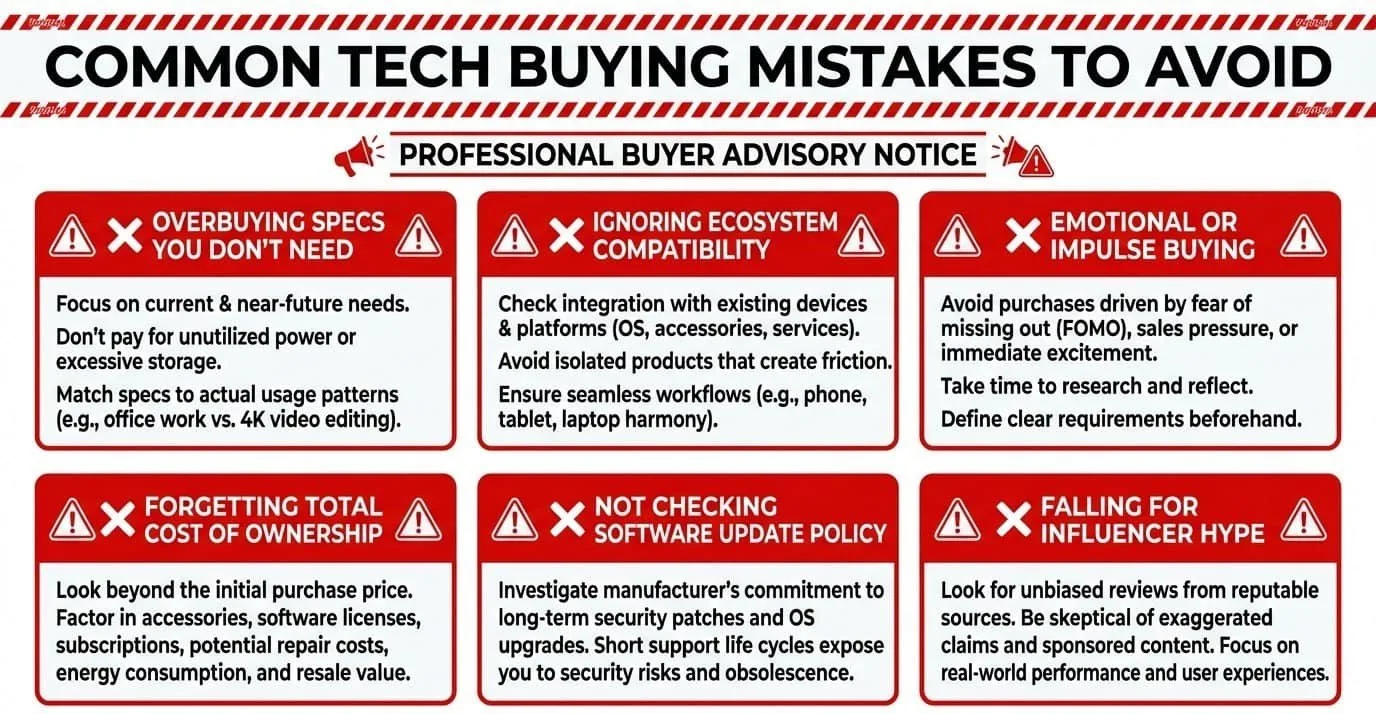
Even with research and comparison, many buyers still make predictable mistakes. These errors don’t happen because people lack intelligence — they happen because marketing, urgency, and information overload cloud judgment.
If you want to truly understand how to choose a tech product wisely, avoiding these common pitfalls is just as important as following the right steps.
We’ve covered these errors in more detail in our article on common mistakes when buying electronics, including how to prevent costly regret.
Overbuying Specs
One of the most common mistakes is buying more power than you actually need.
It’s easy to assume that higher RAM, faster processors, or the most premium configuration automatically mean a better purchase. But if your daily tasks involve browsing, streaming, email, and light productivity, you may never fully utilize high-end hardware.
Overbuying specs often results in:
- Paying significantly more upfront
- Reduced value for money
- Carrying unnecessary features
- Faster upgrade temptation when newer models appear
Performance should match your use case — not your fear of missing out.
Ignoring Ecosystem Compatibility
A device may look excellent on its own, but if it doesn’t integrate well with your existing setup, friction builds quickly.
Ignoring ecosystem compatibility can lead to:
- Sync issues between devices
- Limited accessory support
- Extra subscriptions
- Switching costs later
Before purchasing, always ask how the device fits into your current digital environment. Smooth integration often matters more than marginal performance differences.
Emotional Buying
Impulse decisions are expensive.
Limited-time sales, countdown timers, influencer endorsements, and “Best Tech of the Year” headlines create urgency that pushes people to act quickly.
Emotional buying often leads to:
- Purchasing features you don’t use
- Replacing devices too early
- Choosing popularity over practicality
- Ignoring long-term cost
A structured decision framework prevents this. If you’ve clearly defined your purpose, budget, and comparison criteria, emotional triggers lose their power.
Ignoring Total Cost of Ownership
Focusing only on the sticker price is a mistake.
Recurring subscriptions, accessories, repairs, upgrades, and extended warranties can significantly increase the total cost of ownership.
A device that seems affordable at checkout may become costly over time.
Before finalizing your purchase, calculate:
- Ongoing subscription fees
- Accessory requirements
- Repair likelihood
- Upgrade limitations
Looking at long-term value instead of short-term savings leads to smarter decisions.
Buying Without Checking Update Policy
Software support determines how long a device remains secure and compatible.
A device that stops receiving updates may:
- Lose access to newer apps
- Become vulnerable to security risks
- Experience performance issues
Before buying, check how long the manufacturer typically supports its products with software updates and security patches.
Longevity often depends more on software support than hardware capability.
Falling for Influencer Hype
Influencer reviews and tech content can be informative — but they are not always aligned with your specific needs.
Many influencers test products in ideal conditions or focus on niche use cases that may not apply to you.
Hype-driven buying often results in:
- Overpaying for premium features
- Buying for aesthetics instead of function
- Choosing trends over long-term usability
Always evaluate whether the product genuinely solves a problem in your daily life — not whether it looks impressive online.
Tech Buying Checklist: 15 Smart Checks Before You Buy
Quick Tech Buying Framework (7-Step Summary)
If the full guide above feels detailed, here’s a simplified version you can quickly follow anytime you’re evaluating a device.
- Define your real use case before comparing specs.
- Set a realistic budget and calculate long-term costs.
- Understand the core specifications that impact your performance.
- Compare products within the same price tier.
- Check compatibility with your existing ecosystem.
- Evaluate longevity, updates, and upgrade potential.
- Make the decision calmly — not emotionally.
This structured approach prevents impulse buying and keeps your decision aligned with purpose, practicality, and long-term value.
If you’d like to see how I personally apply this process in real-world situations, I’ve broken it down step-by-step in my guide on how I evaluate tech products before buying, where I explain the thinking process I use before committing to any device.
Our Evaluation Approach at USA Tech Deals
At USA Tech Deals, we follow a structured tech buying framework before recommending any device. Every product is evaluated based on real-world usability, long-term value, ecosystem compatibility, update support, and cost efficiency — not marketing claims or brand hype.
Our goal is simple: help remote workers and home office professionals in the United States make confident, informed technology decisions.
Final Thoughts – How to Choose a Tech Product
Choosing technology for your home office or remote work setup doesn’t have to feel overwhelming.
The confusion most buyers experience doesn’t come from a lack of intelligence — it comes from information overload, marketing pressure, and starting in the wrong place. When you begin with purpose instead of specifications, when you think about long-term value instead of short-term excitement, and when you evaluate compatibility instead of popularity, the entire decision process becomes clearer.
Learning how to choose a tech product is not about memorizing processor names or chasing the newest release. It’s about building a simple, repeatable framework:
- Define your real use case.
- Set a realistic budget and calculate total cost.
- Understand the specifications that actually matter.
- Compare products logically within the same tier.
- Check ecosystem compatibility.
- Evaluate longevity and support.
- Avoid emotional buying.
When you approach technology this way, you stop reacting to trends and start making intentional decisions.
The right device isn’t the most expensive one.
It isn’t the most popular one.
It’s the one that fits your needs, integrates smoothly into your life, and continues delivering value long after the excitement of unboxing fades.
If you follow this structured approach consistently, you’ll save time, protect your hard-earned money, and avoid the regret that so often follows impulse purchases.
Technology should simplify your life — not complicate it.
And when you choose with clarity, it will.
When you follow a structured technology purchasing strategy instead of reacting to trends, your decisions become calmer, smarter, and more cost-effective.
Whether you’re evaluating the best tech of the year, searching for best budget tech, or simply trying to avoid a costly mistake, following a structured framework makes every tech decision clearer and more confident.
Frequently Asked Questions (FAQs)

How do I know which tech product is right for me?
Start by defining your primary use case — what you’ll use the device for most of the time. Once your purpose is clear, match specifications like processor, RAM, storage, and battery life to your needs. Avoid starting with specs alone. Purpose-first thinking simplifies the entire decision process.
What should I check before buying electronics?
Before buying any tech product, check:
Your real use case
Budget and long-term cost
Core specifications
Compatibility with your current devices
Software update support
Return policy and warranty
These factors help you avoid costly mistakes and ensure long-term value.
Is it better to buy premium or budget tech?
It depends on your workload and expectations. Budget devices work well for light tasks but may have limited durability or shorter update cycles. Premium devices offer stronger performance and build quality, but can be unnecessary if your needs are basic. For most users, mid-range options often provide the best balance between price and performance.
How much RAM do I really need?
For everyday tasks like browsing and streaming, 8GB is usually sufficient. For multitasking, creative work, or gaming, 16GB provides smoother performance. Heavy professional workloads may require 32GB or more. If you’re unsure, refer to a detailed breakdown of what RAM does and how much is appropriate for your usage.
How long should a tech product last?
A well-chosen device should remain reliable for at least 3–5 years, depending on the category. Longevity depends on build quality, upgrade potential, and software update support. Devices with longer update policies and durable components tend to provide better long-term value.
Is buying refurbished tech safe?
Yes — if purchased from certified or authorized sellers that offer warranty coverage and return policies. Refurbished devices can provide excellent value, especially if they are manufacturer-certified. Avoid unverified sellers with unclear warranty terms.
How important is brand reputation when choosing tech?
Brand reputation matters, but it should not override objective comparison. Well-known brands often offer better ecosystem integration and support, but evaluating specifications, compatibility, and long-term value within your budget is more important than brand name alone.
What are the 5 technology products?
The five most common technology products used daily include smartphones, laptops, tablets, networking devices such as Wi-Fi routers, and smart home devices. These categories cover communication, productivity, and connectivity needs.
How to decide which product to buy?
Start by identifying your primary purpose, set a realistic budget, compare models within the same price tier, read verified user reviews, check compatibility, and evaluate long-term value before making a final decision.
What is the 7-day rule for buying tech?
The 7-day rule suggests waiting seven days before purchasing a non-essential tech product. This pause helps prevent impulse buying and ensures the product solves a real need rather than responding to marketing pressure or trends.
What specs matter most when choosing tech for remote work?
The most important specifications depend on your workflow. For remote work and home office setups, prioritize sufficient RAM for multitasking, a reliable processor, fast SSD storage, strong Wi-Fi connectivity, and long-term software support. Raw power matters less than real-world reliability and compatibility.
Should I upgrade my current device or buy a new one?
Before purchasing new tech, evaluate whether upgrading RAM, storage, or replacing the battery could extend your current device’s life. If performance limitations affect productivity or software support is ending, replacing the device may provide better long-term value.
If you found this guide helpful and it gave you clarity on how to choose the right tech product, consider subscribing to our email newsletter. We regularly share practical tech buying advice, simplified guides, and smart decision frameworks designed specifically for U.S. remote workers and home office professionals — without hype or unnecessary jargon.
Have a question, experience, or insight of your own? Drop your thoughts in the comments below. Your feedback not only helps others but also shapes the kind of in-depth, practical content we create next.
And if you think this article could help a friend, family member, or colleague avoid a costly tech mistake, share it with them. Smart decisions are always better when shared.
𝐈’𝐦 𝐒𝐭𝐞𝐯𝐞 𝐇𝐨𝐮𝐠𝐚𝐧, the writer and researcher 𝐛𝐞𝐡𝐢𝐧𝐝 𝐔𝐒𝐀 𝐓𝐞𝐜𝐡 𝐃𝐞𝐚𝐥𝐬.
I help everyday users understand technology—𝐰𝐡𝐞𝐭𝐡𝐞𝐫 𝐢𝐭’𝐬 𝐜𝐡𝐨𝐨𝐬𝐢𝐧𝐠 𝐭𝐡𝐞 𝐫𝐢𝐠𝐡𝐭 𝐝𝐞𝐯𝐢𝐜𝐞, 𝐝𝐢𝐚𝐠𝐧𝐨𝐬𝐢𝐧𝐠 𝐩𝐞𝐫𝐟𝐨𝐫𝐦𝐚𝐧𝐜𝐞 𝐢𝐬𝐬𝐮𝐞𝐬, 𝐬𝐞𝐭𝐭𝐢𝐧𝐠 𝐮𝐩 𝐡𝐨𝐦𝐞-𝐨𝐟𝐟𝐢𝐜𝐞 𝐞𝐪𝐮𝐢𝐩𝐦𝐞𝐧𝐭, 𝐨𝐫 𝐬𝐨𝐥𝐯𝐢𝐧𝐠 𝐜𝐨𝐦𝐦𝐨𝐧 𝐭𝐞𝐜𝐡 𝐩𝐫𝐨𝐛𝐥𝐞𝐦𝐬.
My content blends deep research, expert-backed insights, and real user feedback to bring you clear, practical, and easy-to-follow guidance. 𝐈 𝐚𝐧𝐚𝐥𝐲𝐳𝐞 𝐩𝐫𝐨𝐝𝐮𝐜𝐭𝐬, 𝐜𝐨𝐦𝐩𝐚𝐫𝐞 𝐟𝐞𝐚𝐭𝐮𝐫𝐞𝐬, 𝐬𝐭𝐮𝐝𝐲 𝐭𝐞𝐜𝐡𝐧𝐢𝐜𝐚𝐥 𝐬𝐩𝐞𝐜𝐢𝐟𝐢𝐜𝐚𝐭𝐢𝐨𝐧𝐬, 𝐞𝐱𝐩𝐥𝐨𝐫𝐞 𝐭𝐫𝐨𝐮𝐛𝐥𝐞𝐬𝐡𝐨𝐨𝐭𝐢𝐧𝐠 𝐦𝐞𝐭𝐡𝐨𝐝𝐬, 𝐚𝐧𝐝 𝐛𝐫𝐞𝐚𝐤 𝐝𝐨𝐰𝐧 𝐜𝐨𝐦𝐩𝐥𝐞𝐱 𝐭𝐞𝐜𝐡 𝐭𝐨𝐩𝐢𝐜𝐬 𝐢𝐧𝐭𝐨 𝐬𝐢𝐦𝐩𝐥𝐞, 𝐚𝐜𝐭𝐢𝐨𝐧𝐚𝐛𝐥𝐞 𝐬𝐭𝐞𝐩𝐬.
𝐇𝐞𝐫𝐞 𝐨𝐧 𝐔𝐒𝐀 𝐓𝐞𝐜𝐡 𝐃𝐞𝐚𝐥𝐬, 𝐲𝐨𝐮’𝐥𝐥 𝐟𝐢𝐧𝐝:
Tech buying guides based on verified data and side-by-side comparisons
Product insights that highlight pros, cons, and real-world use cases
Step-by-step tutorials for fixing, optimizing, and understanding devices
Home-office and productivity setup advice
Educational articles that simplify complicated tech concepts
Video explanations featuring me as your on-screen tech guide
𝐌𝐲 𝐦𝐢𝐬𝐬𝐢𝐨𝐧 𝐢𝐬 𝐭𝐨 𝐡𝐞𝐥𝐩 𝐲𝐨𝐮 𝐦𝐚𝐤𝐞 𝐬𝐦𝐚𝐫𝐭𝐞𝐫 𝐝𝐞𝐜𝐢𝐬𝐢𝐨𝐧𝐬, 𝐚𝐯𝐨𝐢𝐝 𝐦𝐢𝐬𝐭𝐚𝐤𝐞𝐬, 𝐬𝐨𝐥𝐯𝐞 𝐩𝐫𝐨𝐛𝐥𝐞𝐦𝐬 𝐟𝐚𝐬𝐭𝐞𝐫, 𝐚𝐧𝐝 𝐠𝐞𝐭 𝐭𝐡𝐞 𝐦𝐨𝐬𝐭 𝐨𝐮𝐭 𝐨𝐟 𝐲𝐨𝐮𝐫 𝐝𝐞𝐯𝐢𝐜𝐞𝐬—𝐰𝐢𝐭𝐡𝐨𝐮𝐭 𝐜𝐨𝐧𝐟𝐮𝐬𝐢𝐨𝐧 𝐨𝐫 𝐨𝐯𝐞𝐫𝐰𝐡𝐞𝐥𝐦.
Stay connected for helpful guides, latest tech insights, and smart recommendations.
Follow us on: YouTube • Instagram • Facebook • X (Twitter) • Pinterest • TikTok